Choosing an interior design company in Islamabad affects cost, quality and stress levels for months. This guide explains how established firms work, what documentation to expect and which questions protect your budget.
The interior design market in Islamabad has grown quickly, and with growth has come enormous variation in capability. At one end there are individual decorators offering visual advice. At the other there are established companies with in house design teams, technical draughtsmen, procurement capacity and their own site supervision. Both call themselves interior designers, yet the experience of working with them and the outcome they deliver are entirely different.
Understanding that difference is the most valuable preparation a client can do. A well organised company reduces your involvement to decision making. A weak one transfers coordination back to you, which means chasing carpenters, arguing about material substitutions and discovering that no one is responsible when something goes wrong. The cost difference between these two experiences is usually smaller than people assume, while the difference in stress and final quality is very large.
At Living Solutions Global we operate as a full service interior design and fit out company based in Islamabad, serving residential, corporate, retail, hospitality and clinical clients. Our structure covers design, technical documentation, 3D visualisation, material sourcing, contractor management and site supervision under one accountable team. We also offer the services of a dedicated female interior designer in Islamabad for families who prefer a woman to lead their home project. Because we are a consultancy with four divisions, clients often engage us across more than one requirement, from premises design to business advisory and digital presence.
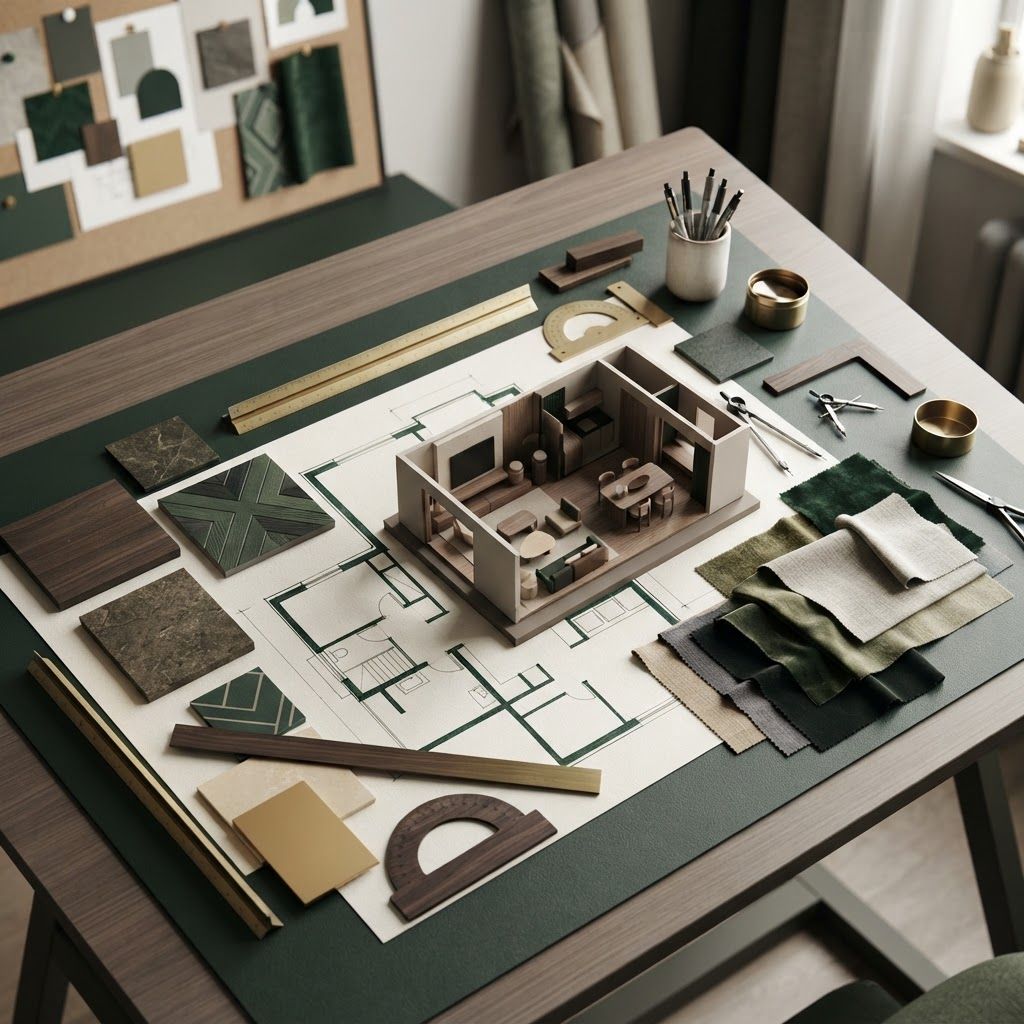
The clearest way to assess a firm is to ask what documents you will receive. A serious interior design company produces a measured survey drawing, a revised floor plan, a furniture layout, a demolition and construction plan where relevant, electrical and lighting drawings, a ceiling plan, plumbing coordination for wet areas, joinery elevations and sections, a door and hardware schedule, a finish and material schedule, and photorealistic 3D views of key spaces.
This package is not bureaucracy. It is cost control. Every item decided on paper is an item that cannot become an argument on site. It also allows genuine comparison between contractor quotations, because everyone is pricing the same specification rather than guessing. Firms that cannot produce this documentation are effectively asking you to accept whatever emerges.
A structured project moves through predictable stages. First comes briefing and site survey, where requirements, constraints, budget range and timeline are established. Then concept design, which explores layout options and visual direction. Once a direction is approved, developed design resolves details, materials and lighting, supported by 3D views for client sign off.
Next is documentation and costing, where drawings are finalised and a detailed budget is issued. Procurement follows, with materials ordered and long lead items prioritised. Execution then proceeds under supervision with staged inspections. Finally comes snagging, where defects are formally listed, rectified and verified before handover, and handover itself, including warranties and maintenance guidance.
Clients who understand this sequence make better decisions, particularly about when to finalise choices. Changes during concept stage cost nothing. Changes after procurement cost money. Changes after installation cost a great deal.
Some companies design and then hand drawings to a contractor of your choosing. Others deliver both design and construction. Each model has merit. Design only can work well if you already have a trusted contractor and are willing to manage the relationship between the two parties. Integrated delivery removes that gap entirely, because the team that drew the detail is responsible for building it.
Our practice covers the full spectrum. We deliver residential interior design for homes, apartments and villas, commercial interior design for offices, retail and hospitality, and complete fit out services where construction, services, joinery and furnishing are handled as one coordinated contract. Working nationally through our interior design in Pakistan practice also gives us a broader supplier and fabricator network than a single city operator can access.
Interior design companies typically charge in one of three ways. A design fee based on area or scope covers documentation and visualisation. A percentage of project value aligns the fee with the size of the build. A turnkey price bundles design and delivery into a single contract sum. None is inherently better, but the basis must be explicit, and you should know precisely what is included, especially the number of revision rounds and the frequency of site visits.
Beware of quotations that seem unusually low. Underpricing is normally recovered later through material downgrades, variation charges or an incomplete finish. A transparent breakdown by trade, with quantities and specified materials, is the best protection available. Insist on it before signing.
Ask to visit a completed project rather than only reviewing photographs, since images conceal detailing quality. Speak to a past client about communication and how variations were handled. Confirm who your point of contact will be and who supervises the site daily. Check whether the firm has legal registration and can issue proper invoices. Clarify the warranty period on joinery, electrical work and installation.
Also assess how they interview you. A company that asks detailed questions about your routines, storage, guests, growth plans and pain points is designing for you. One that immediately proposes a style is selling a template.
Interior projects almost always take longer than clients initially expect, mostly due to procurement and approval cycles rather than construction speed. A single apartment refresh might run six to ten weeks. A full house renovation typically runs three to six months. A commercial fit out depends heavily on landlord approvals and services scope. An honest programme with identified decision deadlines is far more useful than an optimistic one that collapses in week three.
The right interior design company for you is one whose documentation is thorough, whose pricing is transparent, whose completed work stands up to close inspection, and whose team communicates clearly when problems arise. Problems always arise. The difference between firms is how they are handled.
If you are planning a project in Islamabad, our team is ready to visit your property, discuss your requirements and prepare a detailed proposal covering design scope, materials, programme and cost. We would rather begin with a clear conversation about expectations than a portfolio presentation, because that is what actually produces a successful project.

Written by the Living Solutions team
Strategy, design, and trade expertise, all under one roof.
Let's discuss how we can turn your vision into sustainable growth and measurable success.