A practical and inspiring guide to modern bedroom design for Pakistani homes, covering layouts, storage, lighting, materials and colour. Learn how to build a restful, elegant retreat that suits local climate and family living.
The bedroom is the one room in the house that exists purely for the people who live there. No guests to impress, no performance required. Yet in many Pakistani homes it is the last space to receive attention and the first to be filled with mismatched furniture that migrated from somewhere else. That is changing quickly. Homeowners in Islamabad, Lahore, Karachi and Rawalpindi are now approaching the bedroom as a designed retreat, with the same care once reserved for the drawing room. Modern bedroom design in Pakistan is not a copy of a European catalogue. It responds to local conditions: long hot summers that demand serious cooling and glare control, generous extended family households that need clever storage, and a cultural preference for rooms that feel warm and grounded rather than cold and clinical. The result at its best is a space that is simple in line, rich in texture and genuinely restful, with everything you need within reach and nothing you do not need in sight.
Our team at Living Solutions Global treats bedrooms as precision projects, because the difference between a good bedroom and a great one lives in millimetres of joinery and degrees of light. Through our residential interior design service we measure your room, map how you move through it in the morning and at night, and design fitted wardrobes, headboards, bedside details and lighting that work together as one system. Many of our clients specifically request a female interior designer in Islamabad for private family areas such as bedrooms and dressing rooms, and we are glad to provide experienced female designers who visit, measure and coordinate with complete comfort for the household. Backed by our wider interior design in Pakistan capability, we handle drawings, procurement and site supervision so you receive a finished room rather than a set of suggestions.
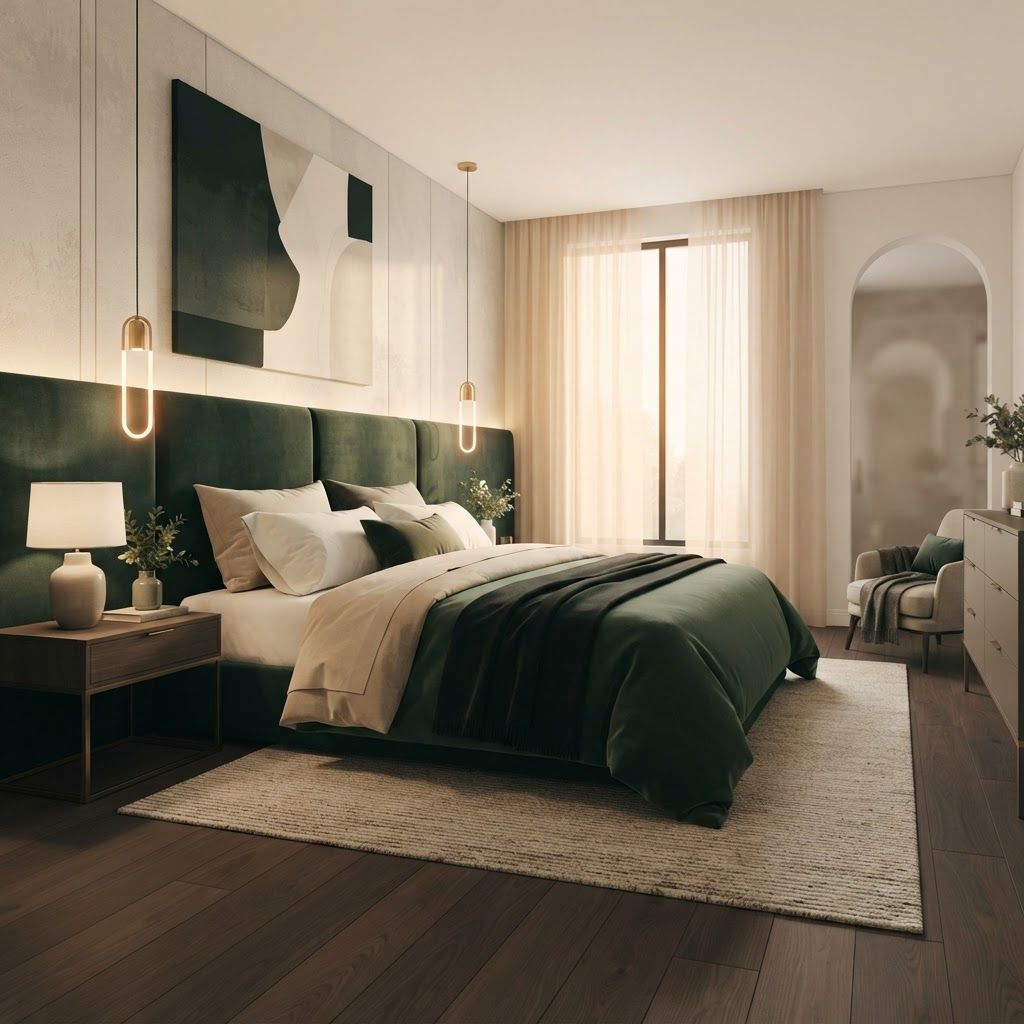
Start with the bed, because everything else follows it. Position the bed on the strongest wall, usually the one you see first on entering, and keep it away from the direct blast of an air conditioner or the swing of a door. Leave at least thirty inches of clear walking space on both sides and at the foot where possible, so making the bed and opening wardrobes never becomes a negotiation. Symmetry is the quickest route to calm, so a matching pair of bedside tables and lamps will settle a room instantly. In smaller rooms, one side can be a slim wall mounted shelf instead of a full table. If the room is long, consider placing the bed off centre to create a dedicated seating or dressing zone rather than stranding furniture in the middle.
Storage is the single biggest factor in whether a bedroom stays calm. Freestanding almari units eat floor area and collect dust on top. Fitted wardrobes running floor to ceiling and wall to wall give roughly forty percent more usable volume in the same footprint and read as architecture rather than furniture. Inside, plan for what you own: long hanging for shalwar kameez and coats, double hanging for shirts and folded trousers, deep drawers for winter shawls and quilts, and a dedicated shelf for luggage. Push and open doors or slim recessed handles keep the elevation clean. Under bed drawers are excellent for seasonal bedding, which matters in a climate where you swap heavy quilts for light cotton twice a year. Anything you use daily should sit between knee and shoulder height; everything else goes above or below.
A single bright ceiling light in the middle of the ceiling is the enemy of rest. Build the scheme in layers instead. Keep the general light soft and indirect, ideally from a concealed cove or a few well placed downlights near the walls rather than directly above the pillows. Add reading light on each side of the bed with adjustable wall lights or pendants, which also frees up bedside surface space. Include a low level night circuit, perhaps recessed strips under the bed or in the skirting, so you can cross the room at three in the morning without waking anyone. Put everything on dimmers and place a switch within reach of the bed. Use warm light around 2700 kelvin in the sleeping area and a slightly cooler, brighter light at the mirror where you need accurate colour.
Deep, muted colours perform beautifully in bedrooms. Warm off white and soft beige walls create a serene envelope, while a single darker accent, such as forest green, olive, terracotta or ink blue behind the bed, adds intimacy and makes the bed feel anchored. Very high contrast schemes and large areas of pure white can feel harsh under strong Pakistani daylight. If you love pattern, keep it in textiles rather than on walls so it can be changed without repainting. Metallic accents in brass or antique bronze warm a scheme far more sympathetically than bright chrome, particularly under low evening light.
No design detail compensates for a poor night of sleep. A quality mattress with the right firmness for your body, changed roughly every eight to ten years, is the highest value purchase in the room. An upholstered headboard in linen, velvet or leather adds comfort for sitting up and absorbs sound in rooms with hard floors and bare walls. For bedding, cotton percale and cotton sateen with a moderate thread count breathe far better in humid heat than heavy synthetic blends. Layer a light quilt at the foot of the bed for cool nights so you are not forced into one temperature all year.
Climate control is a design problem, not just a machine problem. Use two layers at the window: a sheer to soften daytime glare and a lined blackout curtain or roller blind for sleep and thermal insulation. Recess the curtain track into a plaster pocket for a cleaner line. Where street noise is an issue, heavy drapes, a rug over hard flooring and upholstered surfaces make a measurable difference. Plan air conditioning outlets so the airflow crosses the room rather than pointing straight at the bed, and position the indoor unit where its filters can be cleaned easily.
Modern does not mean empty. A large rug that extends well beyond the sides of the bed makes the room feel finished and warm underfoot on cold winter mornings. Mix a smooth headboard with a chunky knit throw, a woven basket and a ceramic lamp base so the eye finds variety. One or two large artworks or a framed textile carry more presence than many small frames. Add a plant that tolerates lower light, such as a snake plant or zz plant, and keep bedside surfaces almost clear. A single tray for glasses, a book and a phone stops clutter before it starts.
A modern Pakistani bedroom succeeds when it is quiet in every sense: clean lines, generous storage, gentle light and materials that feel good against the skin. Plan the layout first, commit to fitted storage, layer the lighting, then let colour and texture do the emotional work. Whether you are furnishing a new house, upgrading a master suite or reworking children rooms as a family grows, thoughtful planning turns an ordinary bedroom into the most valued room in the home.

Written by the Living Solutions team
Strategy, design, and trade expertise, all under one roof.
Let's discuss how we can turn your vision into sustainable growth and measurable success.